Please look at my page called Ride 100: I did it My Way for the final story. Thank you!

Please look at my page called Ride 100: I did it My Way for the final story. Thank you!
In a previous life, I ran a mental health trust for 13 years. It was really hard, but it brought some influence to bear on something that matters very much, i.e. the experiences of 1:4 people, who, like me, are sometimes mentally ill.
In 2010, as Chair of the Mental Health Network, I shared a platform with Health Minister Paul Burstow, Paul Jenkins, then of Rethink, Sarah Brennan of Young Minds and others at the launch of the coalition government’s mental health strategy No Health Without Mental Health. In 2013, I met Norman Lamb (who took over the ministerial role in 2012) and a few other senior colleagues to discuss why it was that the strategy hadn’t completely worked, in our opinion. The shocking evidence of widespread disinvestment in mental health services was by then becoming clearer, rigorously uncovered by investigative journalists Shaun Lintern (HSJ), Andy McNicholl (Community Care) and Michael Buchanan (BBC). Who are heroes in my opinion.
In times of plenty, mental health services have received at least a small share of extra resources available. Professor Louis Appleby’s excellent National Service Framework was delivered from 1999 – 2009 through increased investment in crisis services, early intervention and assertive outreach teams. And it was strictly monitored. Commissioners and/or trusts who thought they knew better than the best evidence of what underpinned compassionate, effective care for people with serious mental illness were found out and given no option but to improve. The architecture that did this monitoring has since been dismantled. We are left with regulation, inspection, adverse incident reporting and stories in the media.
The pressure by local commissioners on providers to swallow the current disinvestment medicine is considerable. Mental health leaders who make a fuss are viewed as lacking loyalty to their local health system. Were the same cuts made to cancer or heart services, there would be national uproar.
This tells us something, which is that stigma towards the mentally ill is alive and kicking within the NHS.
A true story: the other day, I mentioned the wonderful Alison Millar’s Kids in Crisis programme to someone senior from NHS England. I could tell they were irritated to be reminded that very sick children are currently languishing in police cells or being shipped hundreds of miles around the country while desperate clinicians spend hours trying to find a bed. This person actually said that parents are prepared to travel all over the world looking for the best treatment for conditions such as cancer. So why should CAMHS be different? When I reminded them that this wasn’t about highly specialist care, just access to care anywhere, they blamed the failure on local services and moved on to share their insights with someone else.
So we have denial about the impact of disinvestment, as well stigma. And I realise that in my new freelance world, I have a different sort of influence.
Thanks to Paul Jenkins, now CE of the Tavistock and Portman Trust, for his blog this week on the paucity of investment in mental health research. Another example of how stigma is flourishing towards those least able to argue for resources. And to Andy McNicholl for his piece on the bed crisis in adult mental health services, mainly caused because people are being hospitalised when other services have closed, or there is nowhere safe for them to go when they are ready for discharge.
Regarding the NHS Five Year Forward View (5YFV) here’s my 6-point plan for making mental health more mainstream. With measurements. Because if you don’t measure, you can’t manage.
1. Suicide prevention
Make suicide prevention the business of every citizen of the UK. Stop blaming mental health trusts and their staff for failing to keep people alive. The responsibility is much broader than that. Locate suicide reduction planning with Health and Wellbeing Boards. Make it their number one priority, with proper support as well as sanctions for lack of progress.
2. Mental health within the NHS
Expect every provider and commissioner to make the care of people who happen to experience mental illness their explicit business. Start with primary care. Require every NHS employee, including reception staff and everyone who works in a commissioning organisation, to do a minimum 1/2 day training, with an annual update, delivered by experts by experience. Report on compliance via the annual NHS staff survey.
3. Integration
Require local systems to produce integrated commissioning plans for all primary and secondary services. Particularly crisis care; dementia; all major physical conditions such as heart disease, strokes, obesity, diabetes and cancer; neurological conditions such as MS and MND; and musculo-skeketal conditions including chronic pain. Draw on the RAID model for measurement. Allow organisational form to flower according to local need. But also require investment in integrated services through an annual reduction in organisational overheads, and increased investment in the third sector.
4. Public health
Reduce premature death rates in people with serious mental illnesses of up to 25 years by making mental health promotion core business for primary care and secondary health providers in the statutory and non-statutory sectors. Target supportive, evidence based obesity reduction, smoking cessation, substance misuse harm reduction and exercise programmes for people with diagnoses such as schizophrenia, bipolar disorder, PTSD and personality disorder. Set ambitious targets over the next 25 years and monitor hard against them to help turn around the life chances of some of the most marginalised people in society.
5. Making the business case
It is up to the NHS to articulate and prove the business case for a change of approach in welfare for people with long term conditions such as serious mental illnesses. Commission the best brains eg Professor Martin Knapp at LSE to put the evidence together. Which is that it is considerably more costly as well as more cruel to condemn people who experience mental illness to poor, insecure housing and limited, insecure income, and for them to appear frequently and often pointlessly within criminal justice services.
But these costs do not occur in one place. Creating exciting opportunities for engagement and volunteering such as The Dragon Cafe can help people move from being recipients to full participants. Placing employment specialists within mental health teams and incentivising pathways into work are also proven to be highly successful. The alternative, i.e. penalising those in need of help, is counter-productive. It forces people to have to make themselves appear less able, makes them reticent about coming off benefits for fear of never getting them back should they need them in the future, as well as being extremely detrimental to their long-term well-being.
6. Research and improvement
Shine a light on why so little is spent on mental health research, given the financial and life chance costs of mental illness. Do something serious ang longlasting to reverse this. And then measure the impact longditudinally. No-one says we’re spending too much on cancer research, do they? Use that as our benchmark.
AND listen to the eminent and brilliant Professor Don Berwick, who makes the point that inspection never improved any health system. We need to invest in improvement science, architecture and skills for the whole NHS, of which mental health is an intrinsic, integrated part. Calling something NHS Improvement doesn’t necessarily make it an improvement body, by the way. But it is a good start.
I’ve shared these thoughts with the fabulous Paul Farmer, CE of Mind, who is leading one of three national task forces set up to help deliver the NHS England 5YFV. The other two are on cancer and maternity care. I know he wants to do the best he can. But he needs your help.
If you are part of the mental health family, and I would argue that every human being should be, please join in. Let’s seriously increase our ambition for those of us who experience mental illness, and focus hard on a small number of really important things that will really change lives. And then let’s concentrate and not squabble amongst ourselves as we set about achieving them.
That’s how winning teams win, against all the odds.
In my blog last week, I mentioned that my next one might be contentious. This is it.
Tonight, Health Service Journal (HSJ) have announced their inaugural list of Patient Leaders.
I am stunned to be on it. Plus a little bit anxious and also prouder than I have felt for a long time. Here’s why.
I’ve been on a few lists in my time. I remember the first one of influential women in the NHS. Some of us got a bit of stick for that, as did HSJ – “What about the influential men?” came the cry. Take a look at the top of the NHS, and you will see why there is a need for a list with just women on it. Even more so for Black and Minority Ethnic NHS leaders. Hats off to @NHS_Dean who has been open about changing his mind recently regarding quotas on Boards. It’s not too late to join him.
There are many other reasons why such lists can cause controversy. One is that they seem to include all the obvious people, who have reached positions of influence “just” by the nature of their jobs. Who have apparently been in the right place at the right time. Whose mistakes haven’t yet caught up with them. Or who are lucky enough to have a face that “fits”.
I’ve been there and even made such remarks. And I know that, although doing so might have made me feel better about not being on some list or another myself, it also introduced a tiny chip of meanness into my heart which I then had to work very hard to eradicate. Or it risked undermining me and any future good I might bring to bear.
To the people who are feeling mean about this latest list, I say this. Yes, some of the names on it may seem obvious to you. But only they know the personal cost of being there. And yes, there may be some, me included, who are relatively late entrants to the patient leadership world. But that doesn’t make them, even me, unworthy, nor does it in any way diminish the extraordinary contribution of those who have been doing this labour of love for much longer than the rest of us.
Being a member of an exclusive, perhaps even excluded club may feel good, especially one whose purpose has been to act as a ginger group. But patient leaders are doing work that is too important to remain on the outside looking in. One day, and I don’t think it will be all that long, we will see experts by experience appointed into paid leadership roles right across the NHS and care system, as a matter of course. We must of course protect their independence. But we must also stop seeing them as an optional, expensive, fortunate and patronised extra.
There is nothing I did throughout my 41 year NHS career that was harder than sharing my own experiences of mental illness, facing up to going back to work after my last episode of depression, and then retiring, I hope with dignity, to forge a new career as a writer and mental health campaigner. I know it will have been equally hard for others to have followed their personal, not always chosen, path.
So let us warmly thank EVERY patient and carer leader for the courage, wisdom, creativity and generosity they bring to improve our less than perfect, still beautiful, deeply precious NHS. And to all those on tonight’s list, here’s to you. I feel humbled to have joined your extraordinary ranks.
*With thanks to the extraordinary Kate Bornstein, whose philosophy on life is “Do whatever it takes to make your life more worth living. Just don’t be mean.”
I’ve been collecting questions and comments about blogging recently. Here are some of them, with my thoughts. I’d love to hear yours.
1. Why do you blog?
This is a bit like asking why do you breathe. Because I have to. I’ve always used writing to explore ideas and work out what I think. And I’ve always shared it. Blogging is just the latest way to do this. There will no doubt be others.
2. I don’t know how you find the time
Writing a blog doesn’t take as long as you might think. Also, I no longer have a full time job – although I found it helpful to write a weekly blog even when I did. Nowadays, there are other things I don’t do as much of as perhaps I should. Such as finishing the book I am writing…
3. There are so many blogs. I don’t have time to read most of them
No one expects you to. There are also many millions of books, articles and other forms of writing. Some of us have voracious appetites for reading. Others are more choosy. Both are OK, as long as you don’t only read things you know in advance you will agree with. Reading is meant to broaden the mind. And make you think.
4. How do you know if people read your stuff?
This is why blogging is so great. Back in the day of articles appearing in print only, you might know how many people had bought the newspaper or journal. But you’d no way of knowing who had read your piece. With online blogs and articles, at least we now know exactly how many have opened it, even how long they have lingered there. Although whether they actually read it remains their private business!
5. What if no-one reads your blog?
That’s OK. I have had blogs that were looked at by 1,000 people within a few hours, and others which struggled to reach 200 people over a whole week. It can be hard to work out which will be which in advance. It helps to consider whether the title is appealing, and also whether I am saying something original or even interesting; sometimes only clear with hindsight! The ones that seem most popular tend to be when I write about something that other people might have wanted to say, but were too scared to. Or where I talk about my personal experiences of difficult stuff, and what I have learned.
6. I’d like to write an opinion piece but I’d hate to get some of the horrible feedback I’ve seen you getting
This is interesting. At first, the online mauling of people like me who express their views can be distressing. There is something about the ability to be anonymous or apparently unaccountable that makes some people behave in destructive, even vicious ways. I heard Stephen Fry on Desert Island Discs say that he now tweets but never reads the tweets of others. That is really sad. I’m similar to him in two respects: I experience depression from time to time. At those times, there is nothing anyone can say about me that is bad as how I view myself. And when I am well, I have in the past found it almost unbearable when people have criticised me. But…If you ignore negative feedback, you miss learning something. I’m slowly improving at rolling with the punches, and just tuning out the most obviously horrible responses. Increasingly I see myself as an incomplete project that I need as much help with as possible. This makes everything about being alive so much easier.
Also, my wise friend @AlexYLDiabetes tells me that the 80:20 rule should apply, i.e. at least 20% of people should actively object to what you are saying. If they don’t, you are being bland or populist. Thanks Alex, as you know that has been a stunningly helpful insight. Particularly as my next blog after this one might be quite contentious…
7. I’ve been told I should blog but I’m anxious about getting started.
No-one should tell you what you should do. It is your decision. But given that you might want to try blogging, I will just say this. All new things are scary. I have had palpitations just before pressing the Publish button on quite a few occasions. This was one and this was another. It is when you stick your head above the parapet and say what people might not be expecting that you will get the most reaction. I like it when I manage to articulate what others have been thinking but haven’t got round to saying yet. And I like it even more if I can help people to formulate their ideas. If you think you might like these things too, please do have a go.
8. How does blogging make you feel?
Mainly happy. I honestly love it. As I do discussing ideas face-to-face, reading and hearing what others have to say, finding my thoughts shifting, and finding ways to explain what I think through the powers of story-telling.
And I love online conversations, especially on Twitter, which is made for ideas. As well as pictures of cats.

William in the garden
Suicide is one of the last taboos. So much so, that some internet service providers (ISPs) block websites that name it, for fear they are pro-suicide or that just mentioning the word may somehow encourage it. Even my little blogsite has been affected. Thanks to those who told me about two ISPs who were blocking me, and to BT who fixed it fast. And thumbs up to Virgin Media whose initial excuses were unimpressive, but who sorted it out eventually.
I was thinking of the taboo of suicide when I met some wonderful people in Devon recently. Some had been directly affected by suicide, such as the couple who lost their 18 year old son in 2011 and now campaign to raise awareness, and promote a young people’s helpline and two excellent training courses, Safe Talk and ASIST via suicide prevention charity Papyrus. Some were like me and experience suicidal thoughts from time to time. And some were just good, kind people who help others in their chosen careers or as volunteers. They are all part of the South West Suicide Prevention Collaborative.
I shared some of my personal story with them and why I believe now more than ever that preventing suicide is everyone’s business. It is definitely not just the responsibility of staff who work in mental services, who can get blamed for not keeping someone alive, rather than praised for all the times that they have. Staff need support at such times because they feel devastated at the loss of a patient who they care about deeply. How can we expect them to be compassionate to others if we treat them with so little compassion?
Actually, this applies to all of us. Telling people who work in public services to be more compassionate while treating them without dignity, respect or kindness is the ultimate irony. And yet it is played out in many places every day. Including much of the media.
I said something at the event that isn’t currently fashionable. I don’t think it is is possible to prevent every death by suicide. But I do think that we can do very much more IF we make suicide prevention the business of families, friends, neighbours, schools, workplaces, all public services rather than just the obvious ones, the media, shops, cafes, bars, the voluntary sector, faith groups, social groups, sports clubs…everyone. And if we talk about it with more understanding and less rush to judgement, I believe we will gradually lose the taboo. But we still have far to go.
It isn’t just those of us who experience mental illness who think about killing ourselves. Death of a loved one, job loss, other sorts of loss, crippling debt, loneliness, isolation or an overwhelming sense of hopelessness about the future can all be causes. One of the people at the Devon conference spoke bravely about the corrosive impact of the downturn and benefit changes on those who are least well-off.
Only those who have been directly touched by suicide can possibly know just how raw and awful it feels. It is a grief like no other, because of the guilt and the shame that is still associated with it. I don’t get cross about those who still describe the act as “committing” suicide. They usually mean no harm. Suicide hasn’t been a crime since 1961, but we have some way to go to incorporate that change into our values, attitudes, behaviours and language.
I have spent a lot of my life being ashamed of having occasional suicidal thoughts. I was lucky to learn about Samaritans via an article in Reader’s Digest when I was 15, the same year I saw my first psychiatrist. Their kind, wise volunteers have helped me several times in the past. I even became one myself for a while in my early 20s. But I was going through a rough patch and left without explaining why.
Now it’s payback time. I’m doing a big bike ride to raise money for Samaritans. Apart from a handful of staff at their HQ, all Samaritans are volunteers. Like the two lovely women who spoke at the Devon event about the work they are doing in local schools to raise awareness and offer support in the event of a death by suicide. I am donating my £500 fee from the event this week towards my fundraising target. Every penny I raise will go to keep local branches across the country running and to pay for the calls desperate people need to make. I have a big birthday in August. I’m asking my family and friends to make donations in lieu of presents. I can’t think of a better way to celebrate reaching 60.
We can all help one another. That man sitting on the station platform all alone? How long has he been there? Could you get over your reluctance to appear interfering and take a moment to ask him how he is? What about the elderly neighbour whose partner has recently died and who hasn’t been seen for a while? The young person at work who takes frequent days off? The friend who has been made redundant? Even the chief executive who has apparently made a mistake and is getting a mauling via social media. We can all do our bit to be kind, because that is all it might take to save a life.
And as we say at Grassroots, the wonderful suicide prevention charity in Sussex of which I am a trustee, here’s to life.
I’ve had a mixed week. Yesterday I was in Leeds with people who mainly work in the local NHS, voluntary sector and local authorities and share an interest in helping vulnerable people. The conference was called #puttingPeoplefirst. It was enlightening and uplifting. I observed a groundswell of support for a different way of being at work, where people bring their whole and unique selves to bear on issues that matter, where failure is seen as an opportunity for learning rather than a weakness to be vilified, and where treating patients/clients/service users with deep and real compassion is underpinned by working with love and compassion with one another.
Sounds a bit wooly and Buddhist for you? Then listen up. There is an increasing body of evidence that staff, from cleaners to chief executives, who are encouraged to operate with integrity and openness provide better, safer, kinder care. And this stuff isn’t new. Thank you @jackielynton for reminding us of our old friend Donabedian, who wrote wisely about improving quality before anyone else had thought of it, and said that it started with love.
If you don’t already follow @johnwalsh88 on Twitter or read his Yes To Life blog, and you like the sound of the conference, I’d encourage you to do so. I cannot thank John enough for inviting me. Or to the other organisers and speakers and to everyone there who was so honest and kind, including when they challenged one another.
Meanwhile, in another part of the forest, a senior public servant has selflessly stepped down from a job they openly loved despite having done absolutely nothing whatsoever wrong, and indeed a considerable amount right, in order to meet the political ends of people who appear simply to be throwing their weight about. And is being vilified online for it. What does that say to the thousands this person leads? Are they at similar expedient risk?
And in yet another part of the forest (I do like that saying, please tell me if I overuse it) senior people who should know better have been talking about “Never Events” as if by giving something a threatening – sounding name, it will stop it from happening. Actually, what it does is make staff very, very scared. And scared people are less creative and more likely to cover bad things up and to go off sick with stress. Or worse, come to work when they aren’t psychologically fit enough to care for themselves, never mind others.
Here’s a precis of what I said at the conference about authentic leadership:
If you are in a leadership role and you see a colleague who is having a tough time, please don’t metaphorically cross to the other side of the road as though they had some toxic disease you might catch. And please don’t believe the shit you read online or even join in the anonymous bear – baiting that passes for acceptable comment these days. Instead, offer them your genuine support.
Because you never know, one day, it could be you.
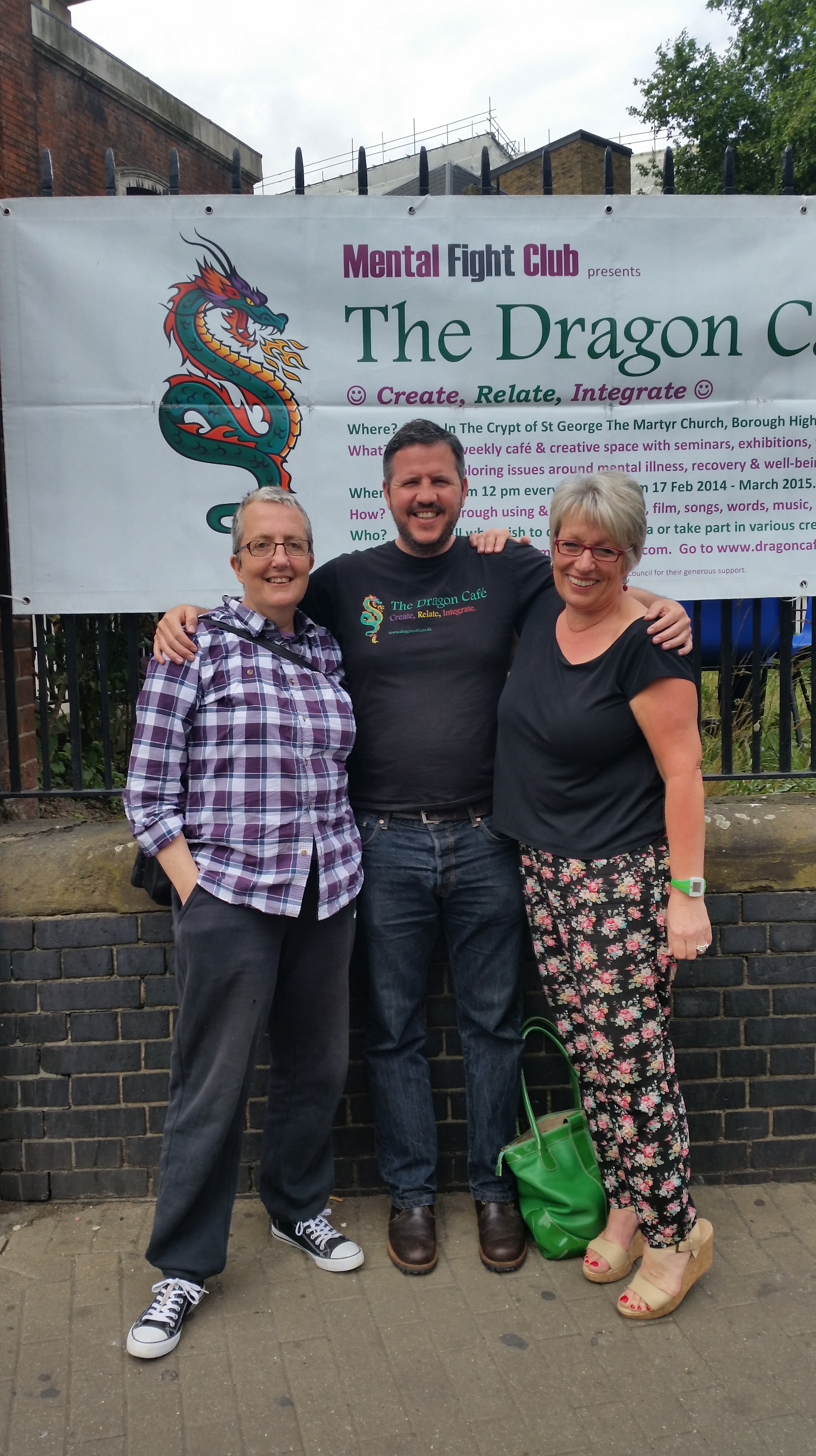
Sarah and Thomas, Seth and Lisa outside Dragon Cafe
Being freelance has many joys. One is being able to follow-up interesting invitations as quickly as I please. I met Sarah and Thomas Tobias at the Design in Mental Health Conference on 19 May 2015. Her description of The Dragon Cafe was really appealing. So yesterday I found myself there. It happens between 12.00 – 20.00 every Monday in the crypt of St George The Martyr Church in Southwark, London SE1. And it is like nothing else I have ever experienced.
In two large basement rooms plus limited outside space, an average of 220 people a week drop by to take part, free, in many activities including art groups, various dance classes – yesterday was a brilliant African dance session – Tai Chi, mindfulness, chess, well-being sessions, massage, creative writing, or just chilling out. Some chat, others sit or lie quietly on beanbags. Some are clearly not as well as others, but everyone attends as an equal voluntary member. I have signed up, as have 4,500 others who have attended since the cafe first opened in October 2012.
An important part of being a cafe is the food, which fills the air with fragrant herbs and spices to tempt any appetite, served with care on china plates and eaten at comfortable tables kept clean and fresh by volunteer staff. I ate a delicate cauliflower and vegetable stew with brown rice. It cost £5. I could have had soup with artisan bread for £2, tortilla with a bowl of salad for £4 or beans on toast for £1. I also spotted brownies, flapjacks and scones, all freshly made. For many members, this is the only opportunity in the week to eat home-cooked food.
The cafe is organised by Mental Fight Club, a charity which found its roots in the work of poet Ben Okri who himself was inspired by William Blake, and by Blake himself, whose words taken from Jerusalem I have used as the title of this blog. The charity embraces difference, and seeks to work in a complementary way with statutory services. They have achieved funding from the Maudsley Charity, Guy and St Thomas’ Charity and Southwark CCG to keep going despite swingeing cuts to voluntary services elsewhere. Long may they continue, because they are enabling people to live well and stay well, and to cope with life at times when they are less than well.
Increasingly, I am drawn towards magical realism in my creative reading and writing. Something Matt Haig said the previous day on Twitter chimed with what I heard and felt yesterday:
https://twitter.com/matthaig1/status/607856259346386944
We need to open our minds to how we help people. I believe strongly in the need for NHS mental health services to be properly commissioned, funded and supported. But the NHS cannot and should not do everything. The voluntary sector, when it is good as The Dragon Cafe, can make the difference between existence and enrichment and fulfilment.
And it can teach the NHS how to do things. I wasn’t surprised to learn that Mental Fight Club has been working with senior psychiatrists in training to provide a safe space for them to explore the dilemmas and trauma they experience in the course of their work. If you didn’t see Alison Cameron talking about what happens if you don’t support staff who experience trauma, I highly recommend her session here:
What Alison said made me think very hard about how we do, and don’t, support staff who daily deal with matters of life and death, and sometimes feel traumatised because they cannot achieve what they consider to be optimal care. Inspection, standard setting, performance management, serious incident reporting, root cause analysis, NICE guidance and all the rest are, may I say, not the whole or even the most important part of the answer. Only by recognising the needs of those doing the caring, and meeting these in ways that are meaningful to them will we truly design compassion into public services.
Do visit The Dragon Cafe. You will see what I mean.
“I will not cease from Mental Fight,
Nor shall my Sword sleep in my hand:
Till we have built Jerusalem,
In England’s green & pleasant land.”
This week, NHS folk (patients, policy makers, clinicians, managers) gather in Liverpool for the NHS Confederation Conference. I’ve been to quite a few in my time. Here are my tips for getting the most from this annual NHS jamboree.
You can prepare by following some great NHS people on Twitter. I’ve already mentioned @allyc375. Here’s a few more: @WhoseShoes, @NHSConfed_RobW, @NHSE_Danny, @ChrisCEOHopson, @Saffron_Policy, @HPIAndyCowper, @Crouchendtiger7, @HSJEditor, @SamanthaJNHS, @antonytiernan, @anna_babic, @DrBruceKeogh, @JaneMCummings, @helenbevan, @jackielynton, @DrUmeshPrabhu, @JamesTitcombe, @NHS_Dean, @KarenLynas2012, @yvonnecoghill1, @2020Health, @Damian_Roland, @BCHBoss, @nickyruneckles, @paulfarmermind, @KMiddletonCSP. Of course there are many more wonderful NHS folk on Twitter, but the ones on this list are definitely at the conference this year. Please seek them out and say hi, and send best wishes from me. And expect a warm welcome back.
I recommend that you follow the conference chair @tweeter_anita. I hope she will mention her stunning new book Sophia, the biography of a forgotten Indian Princess who became a suffragette. It has reminded me that keeping quiet and toeing the line never got anything important done. And causes me to wonder how it can be that in 2015, with NHS staff being 70% women and 20% BME, Anita was left to interview 6 white men who are, collectively, in charge of NHS commissioning, public health, regulation and training. I’m not criticising the incumbents, just the system that perpetuates this shocking lack of diversity at the top. All the more reason to dig deep and support the statue Mary Seacole, which will commemorate not only Mary, but all women and BME people who have dedicated their lives to caring for the sick and wounded.

Please support the Mary Seacole statue appeal http://wp.me/P4ZnZz-3Y
So listen hard, make some noise, have fun and be kind. I hope you have a wonderful conference.

With thanks to @MarkAxcell for the lovely poster.
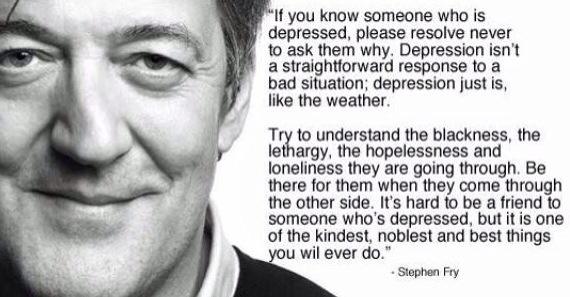
Dear Friend
I saw the above from Stephen Fry a few days ago and loved it. It made me think how much I have to thank you for.
My life is a bit of a roller coaster. It has taken me nearly 60 years to learn that, no matter how much I try, I can’t completely change that, although I am at last learning to recognise my triggers and be kinder to myself and thus to others. You help to make the ups less scary and the downs a tiny bit less grim.
With my love and thanks to you for choosing to become and to stay my funny, kind, wise and very dear friend.
From me xxx
When the NHS was created in 1948, 64 was considered elderly. Both my grandfathers died during the 1940s aged 50 from what we now know to have been smoking related illnesses, having served in the WW1 trenches. My maternal grandmother died aged 65. My other grandma managed to last a bit longer; she died in December 1982 aged 79. 3 out of 4 died in their own beds at home.
I was born in 1955, a child of the NHS. I have worked in it since aged 18. The NHS was set up to improve the extremely poor health of the nation after World War 2, with clinics providing advice and free milk, vitamins, orange juice and cod liver oil, as well as weighing and measuring children, hearing and eye tests, free dentistry, and checking for lice, nits, scabies and rickets. A mass free screening and vaccination programme began for common killer diseases such as smallpox, diptheria, tetanus, polio and TB. Going to the clinic with my mother and younger brothers was fascinating and memorable. Providing care free at the point of delivery to people who were sick or injured was a massive bonus for the public, but its wasn’t intended to be the main aim of the new NHS.
Despite these wonderful founding principles, the NHS quickly began to increase its focus on treating sickness. The status of hospital medicine has always been greater than public health or primary care; this continues today. Radical health promotion initiatives such as the Peckham Experiment sadly closed down before they had a chance to prove themselves.
I trained as a health visitor in 1978, having been inspired during my hospital nurse training – in 1975 I went out for the day with the local health visitor. As well as admiring her cream Morris Traveller and adorable spaniel puppy, I will never forget one visit. In a tiny cottage in a village outside Cambridge, we called on an elderly lady. I remembered her in hospital after a massive stroke, lying with her face turned to the wall. Back home, despite needing two sticks and very limited speech, she ushered us into her cosy kitchen, all smiles, and made us tea and biscuits while her cat snoozed on the sunny windowsill.
Community services (those outside hospital that either help people to stay healthy or look after them at home when they are ill or dying) and mental health services have always been the Cinderellas of the NHS. Never more so than in the last few years, when they have experienced unprecedented cuts in order for commissioners to continue to pay for increasingly sophisticated physical hospital interventions.
Today I have a lovely gig: joining 100 or so folk from the NHS and social care system in Kent, Surrey and Sussex, all of whom want to improve care for older people. It is organised by the KSS Academic Health Science Network. Life expectancy in Kent, Surrey and Sussex is the highest in the UK. Were it not for pockets of significant deprivation along the Kent and Sussex coast, and the appalling fact that people with serious mental illness live 20 years less than the population average (25 years less than the KSS average), it would be even higher. It is common for acute hospital wards to be entirely populated by people in their mid 90s and above. The people attending the event know things have to change. Medicalising old age is cruel as well as extremely costly.
It is, fortuitously, Dementia Awareness Week and Dying Matters Awareness Week. I know from the research of my brilliant ex-colleague Professor Sube Banerjee that only 18% of people who have dementia only have dementia. The majority have between 2 and 7 other significant health conditions that seriously affect their lives. The way we run the NHS is simply not serving their needs, despite very elderly people being its majority users. I also know from the wonderful work of organisations such Dying Matters that these days, most people die in hospital despite very much preferring to be cared for at home.
Today, we will be encouraging the people at the event to face this enormous challenge together. We have to do things differently. It says so in the Five Year Forward View. The attendees at this event are to some extent, like those involved in the vanguard sites across the country, the converted. But even they will have to throw away beloved ideas and think the unthinkable.
I am indebted to @HannahTizard on Twitter for this lovely infographic about tall poppies.
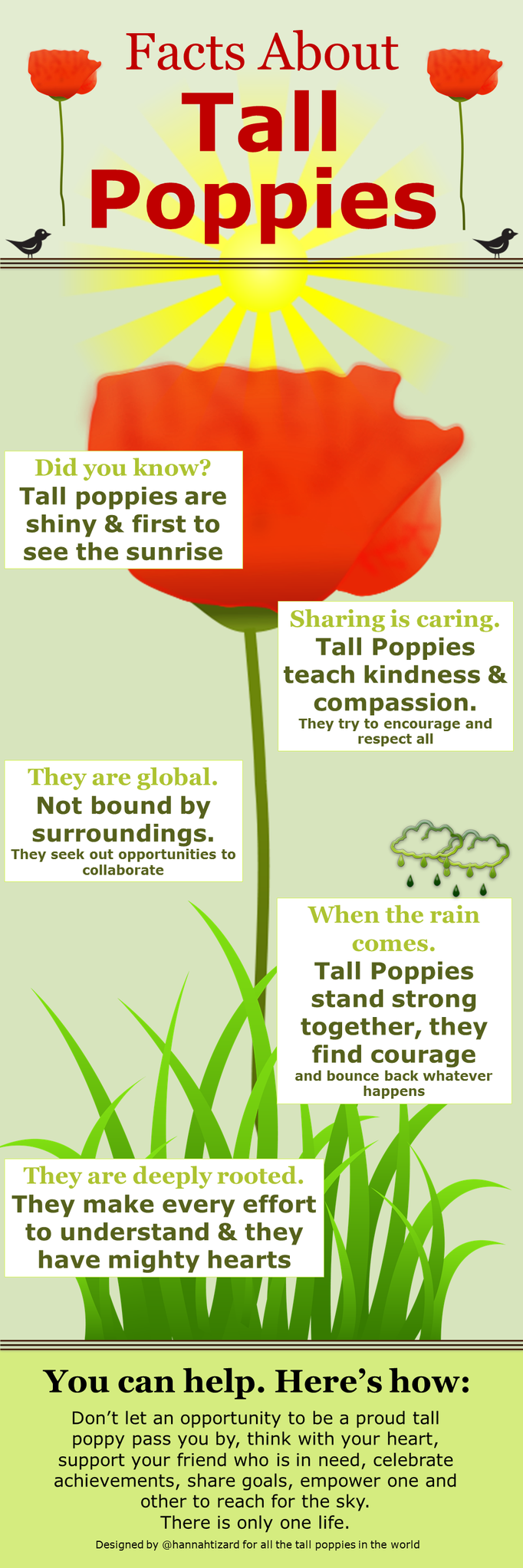
Tall poppies may experience meanness from others because they are full of ideas and are not afraid to challenge the status quo. They are always thinking about how to do things better and are not prepared to accept mediocrity, especially when it harms others.
I will be using this lovely infographic today to encourage the people at the event, who I think of already as tall poppies, and giving them a link to this blog so they have a reference to keep.
I hope you find it helpful too. Please be a tall poppy; challenge the status quo if you think the care you provide or commission isn’t what you think you would want yourself when you are 94 or even older. And do something right now to start making things better for every elderly person who wants fewer tubes up their bottom and down their throat, and more time to enjoy their latter days with somebody kind to sit with them, help them to have a drink and hold their hand.
Meanwhile, as I intend to live until at least 94, I’m off to read Sod 70! by the indomitable Dr Muir Gray, to help me continue to treat my body hard but well, and How to Age by Anne Karpf, from the School of Life series, to help me manage my (sometimes fragile) psyche and approach old age with equanimity and joy.
Do please join me.
Post script: 11 hours after posting this, I’ve already had lots of feedback. One person feels I’m generalising and that the research quoted doesn’t support my view that older people would prefer to avoid unnecessary investigations. I agree that we must ask people and really listen carefully to their answer before subjecting them to invasive tests. Over 100 seem to like it so far.
I’ve also realised that I’ve been channelling the #HulloOurAimIs campaign from NHS Change Day led by my lovely Twitter and real life chum Alex Silverstein @AlexYLDiabetes. So I wanted to mention it. Alex is the tallest of poppies and despite being less than half my age, has taught me loads. Go Alex and thank you xxx
 Lisa Says This